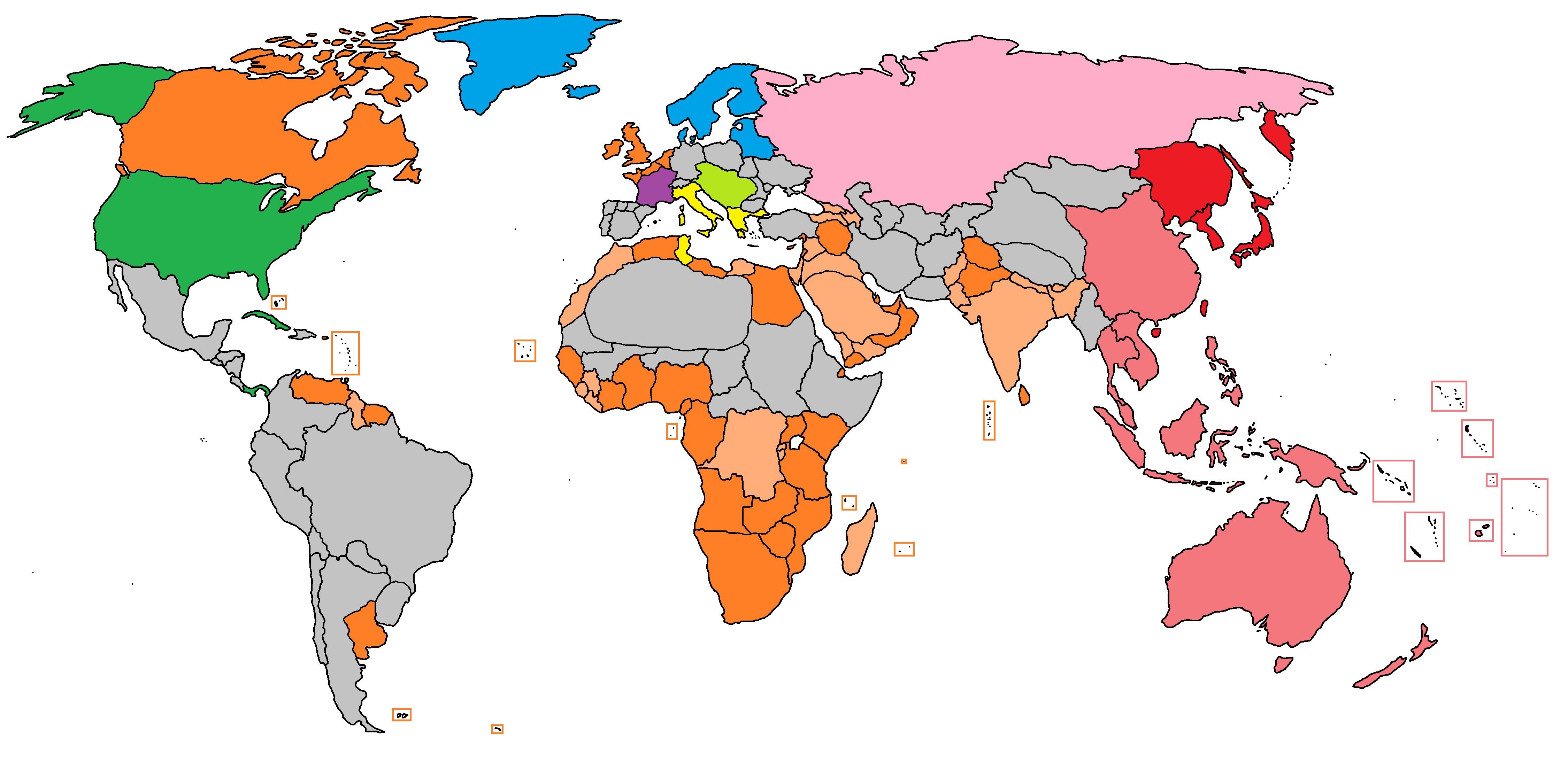
THE ORIGINS OF THE SECOND JAPANESE-AMERICAN WAR
Since the 1980s, the Japanese were the dominant economic power in the Pacific. Their relationship with the Americans began after World War II, when their former enemies became first economic advisers, then employers. In Japan, Japanese business could do no wrong; in an international scandal in the 1980s, it was revealed that one business had even consorted with one of Japan's deadliest enemies, the Soviet Union, selling it vital submarine technology. There was no censure; indeed, the government even defended the company's action! By 1990, Japan was the dominant economic power in the Pacific Rim.
When the Soviet Union collapsed in the late 1990s, the US began scaling back military spending. When the Sino-Soviet conflict broke out and Japan was threatened with nuclear attack by the Soviets, Japan withdrew from supporting the Chinese and the US military alliance. This was the cue for the hawks to begin rebuilding the Japanese military. Eventually the Soviet Union was gone, their were still threats to Japan's security. A capable army and navy were necessary to ensure Japan's safety. The engines of war were supplied by Japanese industry, which had already been manufacturing war material for the US and China. By the turn of the millennium, Japan had a decent-sized army (800,000) and was building a major fleet, second in size only to the US Navy. The hawks were able to justify this tremendous expenditure by pointing out that the reformed Soviet Union was a real threat.
When the Second Great Depression came in 2009, Japan was not as hard hit as the rest of the world. Japan escaped the riots and anarchy that gripped the rest of the planet. Times were hard: power and food were rationed, entire power grids had to switch over to alternate power sources while fuel cells, solar power, and nuclear plants replaced old oil-burners; luxuries were unheard of because industry and raw materials couldn't be spared to make them. Still, compared to the rest of the world, Japan was Paradise.
Within two years, Japan had recovered enough to move out into the Pacific Rim to assist its neighbors. The Japanese sent envoys to China, Taiwan, Indo-China, the Philippines, and even Australia, inviting them to join the Japanese Protectorate. The terms were simple; joining the Protectorate meant being part of the Japan-sponsored trading circle, receiving favorable trade agreements with other countries, getting technical support and military protection from Protectorate (largely Japanese) sources, and in general being part of a elite trading consortium. The alternative was being shut out of the Protectorate, not being allowed to trade with any Protectorate nation, and having any ships or aircraft venturing into Protectorate areas confiscated. It was the classic offer that no one could refuse; they couldn't afford to. Only Australia dictated its own terms for joining into trade agreements with the Protectorate, thereby protecting its own sovereignty and military boundaries - a decision which turned out to be very wise in the long run.
Actual military aggression was rare during the foundation of the Protectorate, and for the most part their soldiers were perceived as beneficial, since they stopped pirate depredations and bandit infestations. Most of the time, the mere threat of military power was enough to bring intractable nations into line. A few countries resisted, and were essentially conquered. These were territories that Japan had lusted after for centuries; Korea, Manchuria, and Taiwan were seized and turned into virtual corporate states. By the year 2021, the Japanese Protectorate controlled the Asian Pacific Rim.
The Japanese planners realized that they would need to fight the United States sooner or later; even in its weakened state, the USA was simply too powerful to ignore and too dominate in the other half of the Pacific Rim to isolate. So they made plans to start the fight, to put the war on their terms. They realized that the goal of decisively defeating the US was beyond their grasp-that would require conquest on land, and there was no way that Japan could ship the necessary troops to America. Even attempting a land invasion would destroy their economy; commercial ships needed to sustain the economy of Japan and the Protectorate would need to be converted to troop transports, and the US submarine fleet (still the world's most deadly) could be expected to inflict crippling losses even before Japanese troops could even land. No, the best that could be hoped for would be to deal the US some sort of public humiliation-a defeat so demoralizing that they would never be able to oppose the Protectorate again.
With this goal in mind, Japanese corporations invested heavily in the oil companies that practically owned Alaska. Hawaii had long been a favorite investment area for yen; now the practice and its quantity intensified. The plan called for insertion of loyal troops into enemy territory, and creation of a fifth column of friendly natives, loyal to their employers first and their country second. These goals were easily met. With these objectives achieved, all that was needed was the order to commence war activities. US forces were limited. It only had 13 Army divisions, with one tied to the east coast and at least two required to remain near the Mexican-conquered part of the United States. One USMC division was neutralized by being stationed at Quantico (for defense of the capital); the other would bear the brunt of Japanese attack, as it was based in California, guarding US naval assets. Although mobile, the Japanese counted on the rest of the divisions being hung up in transit across the nation to trouble spots-from Japan's point of view, it would not be possible for the US to move them across the Pacific to threaten the Protectorate directly.
The US Aerospace Force had three wings of scramjet aerospace fighters, at only 32 aircraft per wing instead of the usual 64. This is in addition to the cargo shuttles used to service and maintain the US satellite defense interdiction network (SDI).
The real threat, from the Japanese point of view, was the US Navy. It was the only force in the US arsenal that could seriously damage the Protectorate, short of nuclear war. The US Navy could move troops across the ocean to menace Protectorate holdings, and had the firepower to devastate the Protectorate merchant marine, thereby crippling import-dependent Japan.
At the time the US Navy consisted of 7 carrier groups, each based around a nuclear-powered aircraft carrier which carried 80+ combat aircraft. There were also 4 battleship groups (SAGs), eight destroyer groups, and large numbers of coastal patrol craft roaming the Caribbean and the southern Californian coast.
The Protectorate Navy was as huge as the Protectorate itself. There were approximately 500 ships in the Protectorate Navy (most of them frigates and patrol boats). These include 12 nuclear carriers, all of them smaller than the American monsters (fielding 64 aircraft instead of the 80+ of the American carriers), nine heavy guided-missile cruisers, thirty fire-coordination ships (AEGIS-style), and a host of smaller ships. Combat task forces were formed around the carriers and a few cruiser groups. At least five of these groups were stuck on-station, patrolling Indochina, the South China Sea, the coast of Korea, or station-keeping off Australia (a dubious ally) and keeping the peace throughout Micronesia. At the beginning of the war, another carrier battle group (CAG) was dispatched to reinforce the Australian force, since the Australians had a habit of siding with the Americans in the past.
The Protectorate was keenly aware of the fact that the US submarine fleet threatened its economic and military existence. To combat this, a crash program had produced a submarine fleet as large as, and even more advanced than, the aging US fleet, although the Japanese submarines were smaller and less well-armed than the US boats. It was believed that most of these submarines were based off the Japanese coast to defend the sea lanes. It was a virtual certainty that some of these subs were ballistic-missile submarines.
The assassination of the US President and Vice-President was apparently the signal to trigger general insurgency actions. Most of these actions were directed at US military installations, with the aim of destroying the United States' ability to wage war on the Pacific front. These attacks-sporadic, ruthless, and extremely destructive-besieged US military bases up and down the West Coast. The naval bases at San Diego and San Francisco were closed off by Marine garrisons, who fired at anyone and anything that came near and wasn't positively identified. Reports at the time indicated that Protectorate forces had engaged in open warfare in Hawaii, and captured the naval base at Pearl Harbor. The Marine brigade in Hawaii was defeated and went underground, as per doctrine, to function as the cadre for a partisan uprising. Across the rest of the USA, secret commando forces continued terrorist assaults on other military site, road infrastructure (predominantly bridges), and airports. In space, secret Japanese kill-sats began destroying the American SDI and surveillance system.
The general response from the American military was been one of shock. Unprepared for a guerilla war, US forces backpedaled into defensive positions. Every US military base went on full wartime footing and was closed to outside traffic. The USAF, confronted with an attack on the SDI system, launched a full wing of its scramjets into orbit to "blast everything that isn't ours" out of the sky. Initial reports indicated a probable loss of 40% of the Protectorates satellite, as well as the confirmed loss of five commercial broadcast satellites, three weather monitor stations, eight independent communications beacons, and an abandoned Soviet science station. Commercial damage in the conflict exceeded $5 billion in the first six hours of combat. The Protectorate declined to engage in scramjet combat - a wise move given the mood of the USAF. The US Navy put every vessel and base on full alert and surged its submarines out of port.
After five years, a few crushing defeats and several surprising victories, the United States and Japan signed a ceasefire agreement as neither side could continue sustained combat operations and neither side sought to escalate to the nuclear level.